
.png)
.png)



Science Feels Religious | Nietzsche Knew Why

“The most dangerous form of blindness is believing that your perspective is the only reality”.
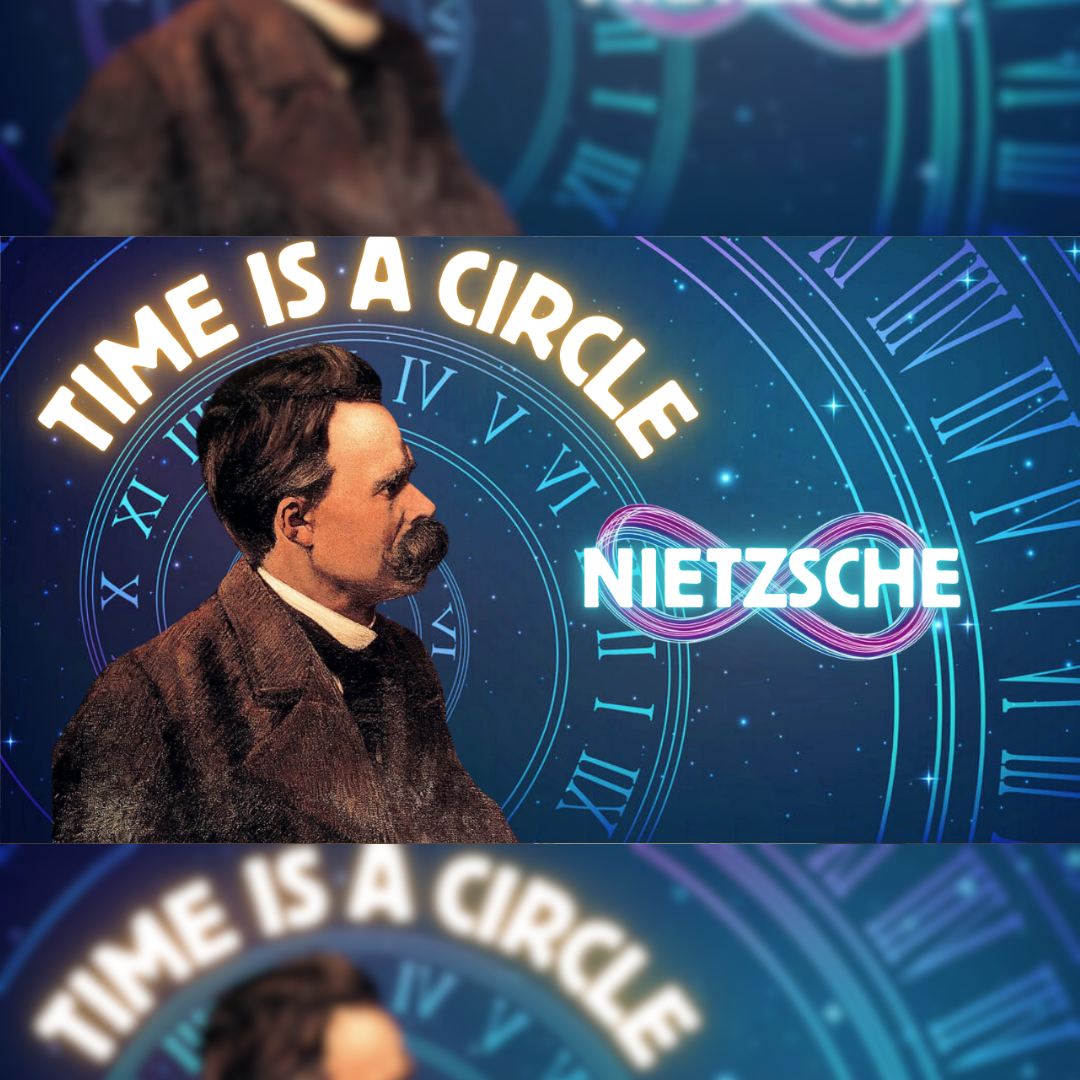
Throughout his rocky life, the German philosopher Friedrich Nietzsche garnered a reputation for shaking up the foundations we hold so tightly as being the true reality. Although he received his flowers after his death, there’s still an aversion to many of his ideas. As such, this is likely to be a spicy video as he brings into question the values we view as acceptable, even today, with them being arbitrarily grounded in the time we inhabit and not fundamental truths. I’ll also crank the controversy up a notch and look into how science uses the same tactics as religion to add conviction when there is none. So, with that said, strap in and let me take you to the late 1800’s when Nietzsche was making waves against the current, back in his glory days before his unfortunate mental collapse.
Science doesn’t create values
“Science first requires in every respect an ideal of value, a value-creating power, in the service of which it could believe in itself — it never creates values”.
You can see why I said it’s going to get spicy. Let me be clear, I’m not about to start dismissing evolution and be ungrateful of scientific advances, without it we wouldn’t be able to interact with each other on this platform. Nietzsche actually goes as far to say that science is the ‘most recent and noblest’ of opposing its exteriors, exteriors meaning anything which uses ideology to prop themselves up like religion or philosophy is capable of doing.
With any long-standing collective organisation comes with it the inevitable dogmatic stiffening. Unfortunately, although science shines a light at the grand ideals of other institutions, it’s now at the top of the hierarchy and, as the Star Wars quote goes ‘has become the very thing it sought to destroy’.
Without creating values of its own, it floats aimlessly without an anchor.
Science is valueless because it lacks any substance in the meaning department, only holding the foundation that the world lacks intrinsic worth and failing to address the deeper existential questions of human experience. It’s great at picking holes in flawed arguments and denying fallacies but when it comes to deciphering its own interpretation of our world, it crumbles at the thought.
In the need to divert attention from science’s value chasm, you hear blanket statements like ‘trust the science’ as if it’s a matter of faith and to question what an expert says is to be ‘anti-science’.
If you’ve seen the show Cosmos, they mention the 16th Century Italian theorist Giordano Bruno, who realised the cosmos was infinite and Copernicus who proposed the Sun-centred model of the universe was right. As it was against the consensus of the time, when he shared this with his peers at Oxford he was laughed out the room.
Nietzsche’s aim was to reveal this blatant dogma and, not being one for half measures, went the distance and tried dismantling what the true intentions of science are. That is to not create values on its own but, rather, employ a value system already in existence which would approve the method of scientific endeavours and keep the status quo afloat.
The final straw
This is the straw that broke the scientists back for Nietzsche; that it’s constructed on the interests of the men of the time. Of course, this isn’t solely science’s burden to bear, every group is capable of this tunnel vision. English Psychologists catch a stray here, with Nietzsche keeping them back as the bad example to stay behind after class. Nietzsche had a seething hatred of this group because they took the values of their own era and purported it to be the right one with no pause or reflection as to whether they are influenced by the time they’re in.
With this takedown of my own English countryman, Nietzsche brings into question the validity of all our values we hold due to the unshakeable connection to the time and place we reside in. We like to judge other civilisations that have been and gone, or even civilisations a hundred miles away as being barbaric, but they, like us suffer with a high degree of tunnel vision, blind to seeing outside of our bubble of acceptable values.
How can we be so sure that what’s acceptable now will be the final version in the spectrum of human experience?
The Ascetic Ideal
Nietzsche doesn’t call it a day there, and instead links science to what is called ‘the ascetic ideal’. So what is it? Well, it’s how the institutions are able to propel their ideologies. Because of this flexibility in appliance, it means very little in itself, other than as a compensation to fulfil their goal. In Nietzsche’s words:
Man “will rather will nothingness than not will”.
It is this desperate desire that leads to the inevitable implosion and you know it’s on the horizon whenever a belief system gains a favourable reputation. As Nietzsche writes:
“As soon as ever a philosophy begins to believe in itself, it always creates the world in its own image”.
So what’s the link with science?
The foundation Nietzsche may be alluding to here is the importance of truth; this is the value science uses which allows it to ‘believe in itself’. This is why the Ascetic Ideal is hard to define as it can mean ‘nothing or too many things’ it is purely to fulfil the ends of the user’s aims and embolden their perceived truth.
This initial similarity of foundation, labelled by Nietzsche as, the ‘overestimation of truth’, raises alarm bells to Nietzsche and goes as far as to implicate religion as being the roots behind this blind objectivity that science to this day hasn’t shaken off.
Nietzsche specifies that it is the ‘belief that truth is inestimable and cannot be criticised’, remember the ‘trust the science’ soundbite I mentioned.
Nietzsche says it more poetically:
“Our flame from the fire ignited by a faith millennia old, the Christian faith that was also Plato’s, that God is truth, that truth is divine”.
When science favours certainty above all else, it becomes closed-minded and rigid, with the only doubt reserved for the outliers with the ideas that shake the certain façade. With certainty then, nothing nuanced can compete.
There’s a recent film called Conclave which, ironically, is from the perspective of the dean of cardinals in the Vatican addressing his equals but it’s warning against certainty is applicable.
“Certainty is the great enemy of unity. Certainty is the deadly enemy of tolerance. If there was only certainty, and no doubt, there would be no mystery, and therefore no need for faith”.
When science aligns with this maxim, it often overlooks—or at least undervalues—the grey area. Take the opposing forces that shape any object as an example of this. True understanding demands attention to an object’s relationship with its opposite. This isn’t unscientific; as the physicist Niels Bohr observed:
“It is the hallmark of any deep truth that its negation is also a deep truth.”
Without drifting too far into the esoteric, think about the Moon’s influence on our biology, the tides, and even our sense of time. Early alchemists, precursors to modern chemists, recognized this influence, linking the Moon with silver, a symbol of reflection, inner wisdom, and transformation. Its counterpart, the Sun, was associated with gold: noble, incorruptible, and eternal.
These symbolic links have no place in modern science and this exclusion, combined with the neglect of the importance of opposites has resulted in science’s value chasm of meaning.
So, symbolic tangent aside, modern science for all its progress which is astonishing, misrepresents what is real, whilst at the same time valuing truth. This is a contradiction and to Nietzsche is the root of what has caused the decline in morality with the blind acceptance of what is the consensus, infecting the values we view as acceptable based on our place in time, only ‘guis[ing] and masquerad[ing]’ the true reality.
Thanks for reading,
Brandon
other related newsletters
tHURSDAY'S THERAPY
Join 10,000+ improving their mental health & social skills 1 Thursday newsletter at a time
Happy to have you here!
try refreshing the page and trying again!
